
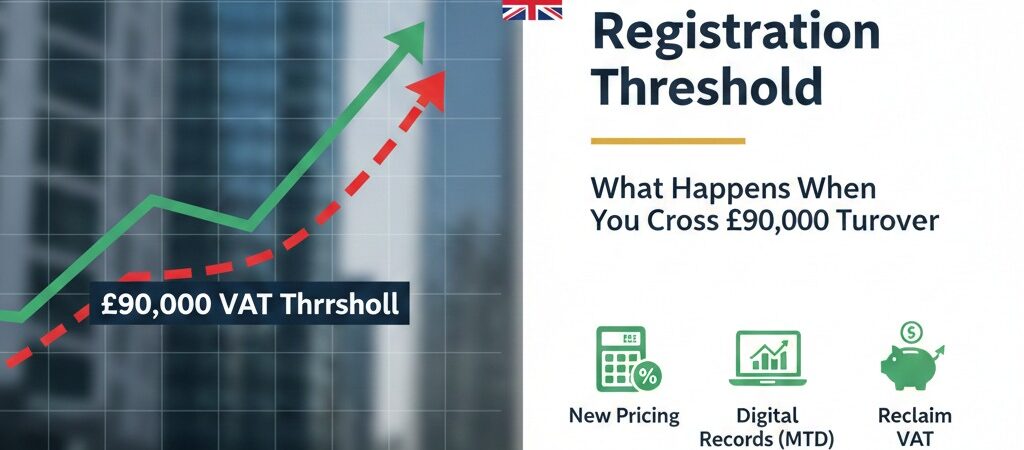
Value Added Tax, commonly known as VAT, is one of the most important tax obligations for UK businesses. Whether you are a sole trader, a growing limited company, or a partnership, understanding the VAT registration threshold and knowing exactly what happens when you cross £90,000 turnover can save you from penalties, cash flow issues, and unnecessary stress.
Many businesses only start paying attention to VAT once HMRC gets involved, often too late. The VAT threshold UK rules are strict, time-sensitive, and closely monitored. With HMRC increasing digital reporting and compliance checks, businesses need to be proactive rather than reactive.
This guide explains the UK VAT threshold 2025, how VAT works in practice, when to register for VAT, and what your responsibilities look like once your turnover exceeds the £90,000 VAT threshold. Everything is explained in simple, practical terms, with examples relevant to UK businesses.
What Is VAT And Why It Matters To UK Businesses
VAT is a consumption tax charged on most goods and services sold in the UK by VAT-registered businesses. While customers ultimately pay VAT, businesses are responsible for collecting it and passing it on to HMRC.
Once registered for VAT, a business must charge VAT on taxable sales, keep accurate VAT records, submit VAT returns, and pay any VAT due to HMRC on time. This is why understanding the VAT registration rules UK is essential before your turnover reaches the registration point.
VAT applies to most industries, from professional services and retail to construction and digital services. However, some goods and services are VAT-exempt or zero-rated, which affects how the VAT turnover threshold is calculated.
Understanding The VAT Registration Threshold In The UK
The VAT registration threshold is the point at which VAT registration becomes compulsory. As per current rules, the VAT registration limit UK is set at £90,000 of taxable turnover.
Taxable turnover means the total value of everything you sell that is not VAT-exempt. This includes standard-rated and zero-rated supplies, but excludes VAT-exempt income such as certain financial services or property rentals.
The HMRC VAT threshold is assessed on a rolling 12-month basis. This is a crucial detail that many businesses misunderstand.
How The Rolling 12-Month VAT Turnover Threshold Works
Unlike income tax or corporation tax, VAT does not follow a fixed tax year. HMRC looks at your turnover over the previous 12 months at the end of every month.
If, at any point, your taxable turnover for the last 12 months exceeds the £90,000 VAT threshold, you must register for VAT.
For example, if your business turnover between April and March exceeds £90,000, you cannot wait until the next financial year. VAT registration becomes mandatory immediately.
This rolling calculation is central to VAT registration UK compliance and is one of the most common reasons businesses register late.
When To Register For VAT After Crossing £90,000
Knowing when to register for VAT is just as important as knowing the threshold itself. Once your taxable turnover exceeds £90,000 in any rolling 12-month period, you must register for VAT within 30 days of the end of the month in which the threshold was breached.
Your VAT registration becomes effective from the first day of the second month after you exceeded the threshold. From that date, you must charge VAT on all taxable sales, even if your registration process is still ongoing.
Failing to register on time can lead to penalties, interest on unpaid VAT, and backdated VAT bills that come directly out of your profits.
What Happens If You Expect To Cross The VAT Threshold
VAT registration is also required if you expect your taxable turnover to exceed £90,000 within the next 30 days alone. This often applies to businesses that secure a large contract or experience a sudden surge in demand.
In such cases, VAT registration must happen immediately, not after the income is received. HMRC takes future expectations seriously, and ignoring this rule can result in compliance action.
Understanding this forward-looking aspect of the VAT registration rules UK is essential for fast-growing businesses.
Voluntary VAT Registration Below The £90,000 Threshold
Businesses do not need to wait until they hit the VAT threshold UK to register. Voluntary VAT registration is allowed and, in some cases, beneficial.
Registering voluntarily can help businesses reclaim VAT on expenses, improve credibility with VAT-registered clients, and prepare for future growth. However, it also brings administrative responsibilities and potential pricing challenges.
Voluntary registration should be a strategic decision based on cash flow, customer type, and long-term plans rather than a one-size-fits-all approach.
How To Register For VAT In The UK
VAT registration is completed online through the HMRC Government Gateway. Once registered, you receive a unique VAT number and access to your VAT online account.
The VAT registration UK process requires business details, turnover information, bank account details, and confirmation of your accounting method. While postal registration exists, online registration is the standard and fastest method.
Once registered, HMRC confirms your VAT start date, which determines when you must begin charging VAT and submitting returns.
What Changes After You Become VAT Registered
Crossing the VAT registration threshold changes how your business operates. You must charge VAT on taxable sales, issue VAT-compliant invoices, and submit VAT returns, usually every quarter.
You can reclaim VAT paid on business expenses, known as input tax, as long as those expenses relate to taxable supplies. The difference between output VAT collected and input VAT reclaimed determines how much you pay or reclaim from HMRC.
This is where good record-keeping becomes essential. Poor VAT records often trigger HMRC compliance checks.
VAT Rates UK Businesses Need To Know
The standard VAT rate in the UK is 20 percent and applies to most goods and services. Reduced and zero rates apply to specific categories, while some supplies are VAT-exempt.
Charging the wrong VAT rate can lead to underpayments or overpayments, both of which create problems with HMRC. Understanding which rate applies to your business activities is a key part of staying compliant after crossing the VAT turnover threshold.
VAT Returns And Payment Deadlines Explained
Most VAT-registered businesses submit VAT returns quarterly. Each return summarises VAT charged on sales and VAT paid on purchases.
VAT returns must be submitted digitally, and payments must reach HMRC by the deadline, usually one month and seven days after the end of the VAT period.
Late submissions or payments can result in penalties under HMRC’s points-based penalty system, making timely compliance essential.
VAT Accounting Schemes And Their Thresholds
Some VAT accounting schemes are available to simplify reporting or help with cash flow. These include the Flat Rate Scheme, Cash Accounting Scheme, and Annual Accounting Scheme.
Each scheme has its own eligibility limits and exit thresholds. While these schemes can be helpful, choosing the wrong one can increase VAT costs rather than reduce them.
Understanding scheme thresholds alongside the VAT registration limit UK ensures businesses make informed decisions.
Post-Brexit VAT Rules And Import VAT
Post-Brexit VAT rules have changed how UK businesses handle imports and exports. VAT-registered businesses can use postponed VAT accounting, allowing import VAT to be declared on the VAT return rather than paid upfront at the border.
This helps protect cash flow and simplifies international trade, but only applies to VAT-registered businesses. Crossing the £90,000 VAT threshold can therefore change how your business handles overseas transactions.
Common VAT Mistakes Businesses Make After Registration
Many businesses underestimate the impact of VAT on pricing, margins, and cash flow. Others fail to track their turnover correctly, resulting in late registration.
Another common mistake is assuming VAT collected belongs to the business. VAT should always be treated as HMRC’s money, set aside until payment is due.
Understanding these risks early makes managing VAT far less stressful.
Why Monitoring VAT Turnover Is Essential In 2025
With the UK VAT threshold 2025 remaining under close HMRC scrutiny, businesses are expected to monitor turnover continuously. Digital record-keeping and Making Tax Digital requirements make it easier for HMRC to identify non-compliance.
Businesses that plan ahead, understand the HMRC VAT threshold, and register on time avoid penalties and maintain better control over finances.
The Bottomline
Crossing the VAT registration threshold is a milestone for any UK business. While it adds complexity, it also reflects growth and opportunity. Understanding when to register for VAT, how the VAT threshold UK works, and what changes after registration allows businesses to stay compliant and confident.
VAT does not need to be overwhelming. With the right knowledge, proper planning, and timely advice, businesses can manage VAT efficiently and focus on growth rather than compliance worries.
If you are approaching the £90,000 VAT threshold or are unsure how VAT applies to your business, early guidance can make all the difference.
Disclaimer: The information provided in this blog is for general guidance and educational purposes only and does not constitute financial, tax, accounting or legal advice. iFiler, registered in England under Company Registration Number 15996173, has prepared this content to offer general insights into financial and taxation matters. Although every effort is made to ensure the accuracy and relevance of the information at the time of publication, no guarantee is given regarding completeness, accuracy or suitability for your specific circumstances.
Readers should not act, or refrain from acting, based solely on the information contained in this content. Professional advice tailored to your personal or business situation should always be obtained before taking any financial or tax related decision. iFiler accepts no liability for any loss or damage arising from reliance on the information presented in this blog.
FAQs
What is the VAT registration threshold in the UK?
The VAT registration threshold is the level of taxable turnover at which a business must register for VAT. In the UK, the current threshold is £90,000, calculated over a rolling 12-month period.
How does HMRC calculate the VAT turnover threshold?
HMRC uses a rolling 12-month calculation rather than a fixed financial year. If your taxable turnover exceeds the £90,000 VAT threshold at the end of any month, VAT registration becomes mandatory.
When do you need to register for VAT after crossing £90,000?
You must register for VAT within 30 days of the end of the month in which your turnover exceeds the VAT registration threshold. Your VAT registration usually starts from the first day of the following month.
What happens if you register for VAT late?
Late VAT registration can result in penalties, interest on unpaid VAT, and backdated VAT liabilities. HMRC may also charge VAT on past sales even if you did not charge customers at the time.
Can you register for VAT voluntarily below the threshold?
Yes, businesses can choose voluntary VAT registration even if their turnover is below the UK VAT threshold. This can help reclaim VAT on expenses and improve credibility with VAT-registered clients.
Does the VAT threshold apply to sole traders and limited companies?
Yes, the VAT registration limit UK rules apply equally to sole traders, partnerships, and limited companies. The legal structure does not change the VAT turnover threshold.
What income counts towards the VAT threshold?
Only taxable turnover counts towards the VAT threshold. This includes standard-rated and zero-rated sales but excludes VAT-exempt income such as certain financial services and residential rent.
Do you need to register if you expect to exceed the VAT threshold soon?
Yes, if you expect your taxable turnover to exceed £90,000 within the next 30 days alone, you must register for VAT immediately, even before the income is received.
How often do VAT-registered businesses submit VAT returns?
Most VAT-registered businesses submit VAT returns quarterly to HMRC. Returns must be filed digitally, and payments are usually due one month and seven days after the VAT period ends.
Does crossing the VAT threshold change how you price your services?
Yes, once VAT-registered, you must charge VAT on taxable sales. This can affect pricing, profit margins, and customer perception, especially for businesses selling to non-VAT-registered customers.